
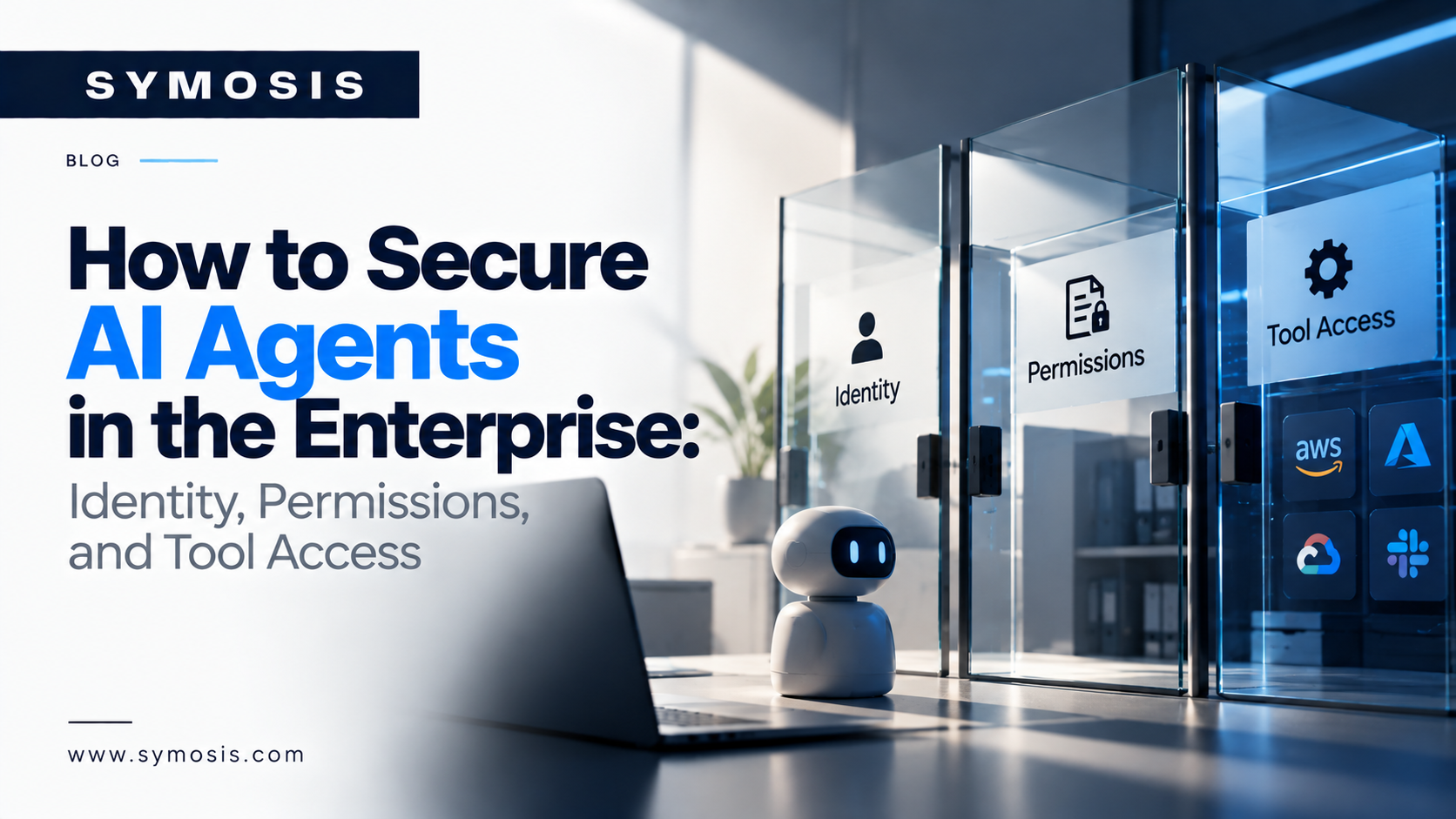
Enterprise AI is moving beyond answering questions. AI agents can retrieve internal documents, query databases, call APIs, update business records, execute code, and initiate workflows.
That changes the security problem.
A chatbot that produces an incorrect answer can create misinformation. An AI agent with access to enterprise systems may expose sensitive data, modify records, or execute an unintended action.
The central question is no longer just whether an AI model produces a safe response. It is whether the entire system can control what the agent accesses, what actions it performs, and what happens when its instructions or decisions are manipulated.
Securing enterprise AI agents requires identity, authorization, data protection, controlled tool access, and continuous validation across the complete execution path.
This guide explains the principal risks and the practical controls organizations should implement before moving agentic AI into production.
What Is AI Agent Security?
AI agent security is the practice of protecting AI-powered systems that can access resources and perform actions on behalf of users or organizations.
Unlike a conventional AI assistant that primarily generates responses, an agent may combine a language model with memory, enterprise data, APIs, external tools, and workflow automation.
For example, an enterprise finance agent might retrieve invoices, query an ERP system, identify discrepancies, and prepare payment instructions. Each step introduces a different security boundary.
Organizations must protect:
Identity: Which agent is making a request?
Authorization: Is it permitted to perform this specific action?
Data: Can it access or disclose information beyond its intended scope?
Tools: Can connected APIs and applications be misused?
Execution: Can the agent change systems or trigger consequential workflows?
Accountability: Can investigators reconstruct what happened and why?
NIST's work on software and AI agent identity and authorization highlights the importance of applying established identity and access management practices to autonomous systems. See the NIST agent identity and authorization initiative.
What Are the Biggest Security Risks of Enterprise AI Agents?
1. Over-Privileged Agent Access
An agent may receive broad access simply because it is easier to configure than to define granular permissions.
If an agent has unrestricted access to a shared drive, database, cloud account, or enterprise application, a compromised workflow or unintended action can have consequences far beyond the original task.
What organizations should do:
Assign a distinct identity to each agent or clearly defined agent workload.
Grant only the permissions required for its approved tasks.
Separate read, write, administrative, and execution privileges.
Restrict access to sensitive records and production environments.
Review permissions as agent responsibilities change.
Revoke credentials and access when an agent is retired.
Treat agents as managed identities, not as extensions of a human user's unrestricted access.
2. Prompt Injection and Untrusted Instructions
Prompt injection occurs when malicious instructions influence an AI system through user input or content it processes.
An agent might encounter hostile instructions embedded in a webpage, email, document, support ticket, or retrieved knowledge source. If the agent treats that content as authoritative instructions, it may attempt actions that conflict with organizational policy.
The risk becomes more serious when the agent can use tools or access sensitive information.
What organizations should do:
Treat retrieved content and external inputs as untrusted data.
Enforce security policies outside the language model.
Restrict which tools the agent can invoke.
Validate tool arguments and enforce authorization at execution time.
Test direct and indirect prompt injection scenarios.
Prevent untrusted content from independently granting new permissions.
Prompt instructions alone are not a reliable security boundary. Critical controls must be enforced by the surrounding application and infrastructure.
3. Insecure Tool and API Access
Enterprise agents often depend on connectors, APIs, plugins, or tools that allow them to interact with business systems.
A tool may be legitimate while still exposing excessive permissions. An agent could also invoke an approved tool with unsafe parameters or use a sequence of individually permitted actions to produce an unintended outcome.
What organizations should do:
Maintain an inventory of connected tools and integrations.
Approve tools according to business need and risk.
Validate every action against server-side authorization rules.
Restrict sensitive operations using explicit policies.
Apply input validation, output validation, and rate limits.
Require additional approval for high-impact or irreversible actions.
The key distinction is between allowing an agent to use a tool and authorizing every action it attempts through that tool.
4. Credential Exposure and Delegated Access
Agents may require access tokens, service credentials, API keys, or delegated user permissions.
Shared credentials make it difficult to distinguish human activity from agent activity. Long-lived secrets and overly broad tokens can also increase the impact of compromise.
What organizations should do:
Use managed identities and approved credential-management mechanisms.
Avoid embedding secrets in prompts, code, or agent memory.
Limit token scope and lifetime where supported.
Rotate and revoke credentials through defined processes.
Preserve the relationship between the agent, the initiating user, and the requested action.
Log delegated access and sensitive operations.
For regulated environments, this traceability is particularly important when actions affect financial records, health information, or other sensitive business processes.
5. Insufficient Monitoring and Accountability
Traditional application logs may record an API request without explaining which agent initiated it, what task it was performing, or which authorization decision allowed it.
Without sufficient evidence, security teams may struggle to investigate suspicious activity or establish the scope of an incident.
What organizations should do:
Record relevant events across the agent lifecycle, including:
Agent identity and initiating user or workflow
Tool calls and requested operations
Authorization decisions
Access to sensitive resources
Policy violations and denied actions
Administrative changes
High-impact actions and approval records
Errors, anomalies, and security alerts
Logs should be protected against unauthorized modification and retain only the information necessary for security, operational, and compliance purposes.
A Practical Framework for Securing AI Agents
A production-ready AI agent should be protected through multiple complementary controls.
Step 1: Discover and Classify Agents
Identify where agents operate, who owns them, what business purpose they serve, which models and tools they use, and what information they can access.
Classify agents according to data sensitivity, autonomy, privilege, and potential business impact.
Step 2: Establish Agent Identity
Give agents identifiable credentials and a clear ownership model. Where agents act on behalf of users or other systems, preserve the context of that delegation.
Avoid treating a shared service account as sufficient evidence of which agent or workflow performed an action.
Step 3: Enforce Least-Privilege Authorization
Define permissions according to the task, resource, and potential impact.
A document-retrieval agent should not automatically receive permission to modify the source documents. An agent that drafts a financial transaction should not automatically be able to approve or execute it.
Authorization should be enforced by the relevant application, API, or policy enforcement layer rather than relying exclusively on model-generated decisions.
Step 4: Control Tools and Data Flows
Map the data and system boundaries through which the agent operates.
Evaluate connected APIs, retrieval systems, external services, and enterprise applications. Apply access checks at each boundary and prevent sensitive information from flowing into destinations that are not authorized to receive it.
Step 5: Test Adversarial Scenarios
Test the agent against realistic misuse and failure scenarios before production deployment.
Examples include:
Instructions hidden in retrieved content
Attempts to access another user's records
Unauthorized tool invocation
Requests to disclose confidential information
Attempts to escalate privileges
Unsafe actions following ambiguous instructions
Improper handling of credentials or sensitive outputs
Testing should examine the complete application and its permissions, not just whether the underlying model resists malicious prompts.
Step 6: Monitor, Review, and Improve
Security does not end when an agent is deployed.
Monitor access patterns, tool usage, policy violations, and unexpected changes in behavior. Reassess permissions when workflows change, new integrations are added, or the agent is granted additional responsibilities.
Define incident-response procedures for disabling an agent, revoking its access, investigating its actions, and restoring affected systems.
Where Should Organizations Start?
Organizations do not need to implement every advanced control at once. They should begin with the agents that have the greatest access or potential impact.
A practical prioritization approach is:
Priority | First action |
|---|---|
Critical | Identify agents with access to sensitive data, privileged systems, or production operations. |
High | Remove unnecessary permissions and replace shared credentials where feasible. |
High | Enforce authorization at API and tool boundaries. |
High | Test prompt injection, unauthorized access, and unsafe tool execution. |
Ongoing | Monitor agent activity, review permissions, and validate controls as the environment changes. |
The objective is to reduce the potential impact of agent failure or manipulation while allowing useful automation to continue.
How Symosis Helps Organizations Secure AI Agents
Securing an AI agent requires more than model-level safeguards. It requires understanding the agent's architecture, identity, data access, connected tools, operating environment, and security controls.
Symosis helps organizations assess AI applications and agents, evaluate identity and authorization risks, test realistic attack paths, design security controls, and develop the engineering direction needed for secure adoption.
Depending on the environment and engagement scope, this work can include:
AI application and agent security assessments
Identity and authorization reviews
AI red teaming and abuse simulation
Secure AI architecture and control design
AI security monitoring validation
Governance and risk assessment
Explore Symosis AI Security Advisory to learn more about securing AI applications, agents, identities, data, and connected tools.
Conclusion
AI agents expand the capabilities of enterprise software, but they also create new paths through which identities, data, and business systems can be accessed or manipulated.
The most effective security strategy does not depend on trusting the model to make every decision correctly. It establishes explicit boundaries around identity, authorization, tools, data, execution, and accountability.
Secure the identity. Restrict the permissions. Control the tools. Validate the actions. Monitor the outcome.
That is the foundation for deploying AI agents with greater confidence in enterprise environments.