
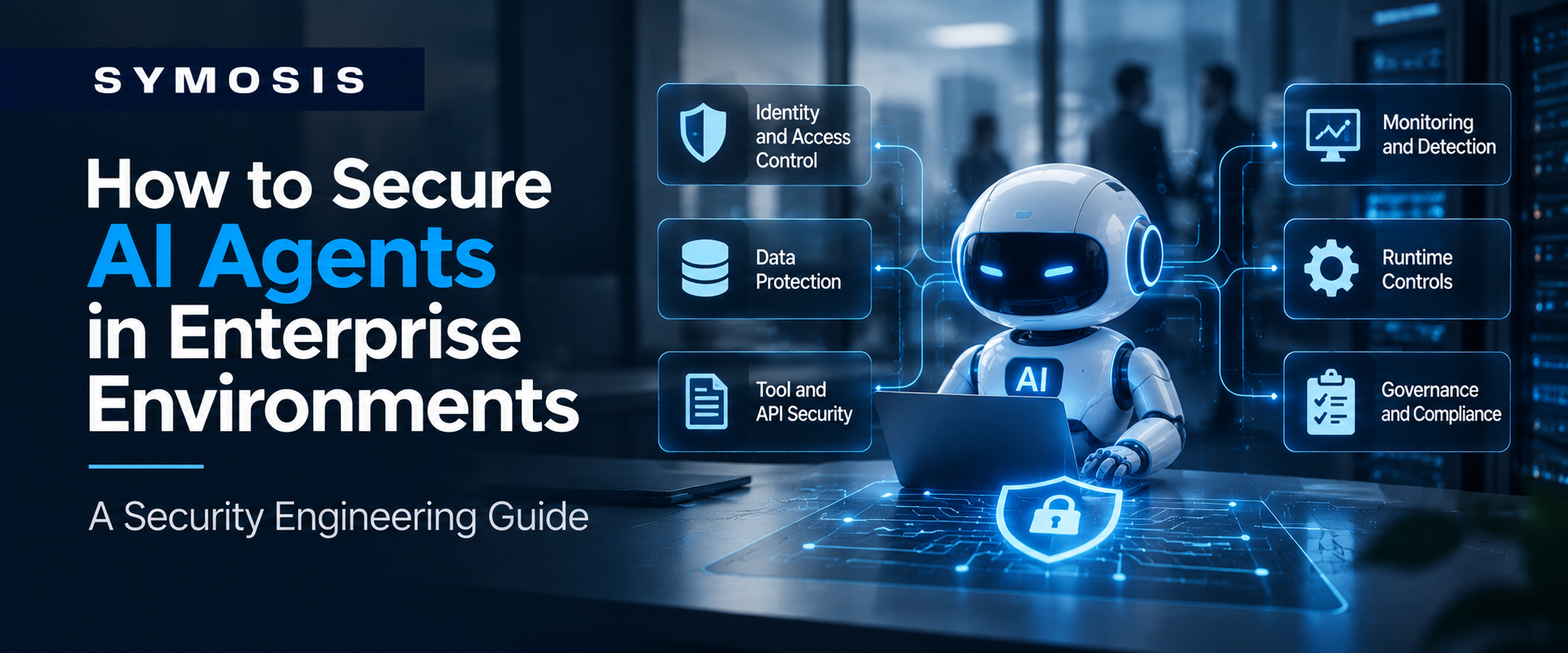
Enterprise AI agents are increasingly being connected to business applications, internal data, APIs, and automated workflows. This changes the security problem.
A conventional application typically executes operations through explicitly defined code paths. An AI agent can interpret natural-language instructions, select tools, retrieve external information, and determine which action to attempt next. Depending on the architecture, those actions may affect sensitive records, infrastructure, or business processes.
The security concern is not simply whether the model produces an incorrect answer. It is whether an incorrect, manipulated, or unauthorized decision can cross a trust boundary and cause a real-world system to perform an action.
Securing AI agents requires controlling what they can access, what they can execute, how their actions are authorized, and how their behavior is monitored.
For enterprise security leaders, architects, and engineering teams, the starting point is a threat model that treats the agent, its identity, its tools, its data sources, and its execution environment as parts of one security system.
What Is AI Agent Security?
AI agent security is the discipline of identifying and mitigating risks associated with AI agents, including their models, instructions, connected tools, identities, data access, and autonomous or semi-autonomous actions.
An enterprise AI agent may perform tasks such as:
- Retrieving information from internal knowledge repositories.
- Reading or updating customer records.
- Calling APIs and interacting with enterprise applications.
- Executing development or operational workflows.
- Coordinating actions across multiple systems.
Each capability creates a corresponding security boundary. An agent that can read a database has a different risk profile from one that can modify records, provision cloud resources, or send external communications.
Consequently, AI agent security cannot be addressed through model-level safeguards alone. The application architecture and underlying enterprise controls must enforce the intended limits.
The Five Security Boundaries of an Enterprise AI Agent
A useful way to assess an AI agent is to examine five connected boundaries.
1. Identity boundary
Which identity does the agent use when accessing an application or service? Is the identity unique, attributable, and governed by an accountable owner?
2. Authorization boundary
Which operations is the agent permitted to perform, against which resources, and under what conditions?
3. Data boundary
Can the agent retrieve or disclose information that the initiating user or workflow is not authorized to access?
4. Execution boundary
Can the agent invoke tools, APIs, scripts, or workflows that create an unacceptable operational impact?
5. Runtime trust boundary
Can untrusted instructions, retrieved content, compromised tools, or unexpected behavior influence actions beyond the agent's approved purpose?
These boundaries should be evaluated together. Strong authentication, for example, does not compensate for excessive permissions. Likewise, a well-restricted identity does not eliminate the risk of sensitive data being exposed through an improperly designed retrieval workflow.
What Are the Biggest AI Agent Security Risks?
Several risk categories deserve particular attention during enterprise AI security assessments.
Excessive agency and privilege abuse
An agent may be given more permissions than its assigned task requires. If an attacker manipulates the agent or exploits a weakness in its workflow, those permissions can increase the potential impact.
The relevant question is not simply whether an agent is authorized to access a system. It is whether every permission and action is necessary for its intended purpose.
Prompt injection and goal manipulation
Prompt injection occurs when malicious instructions in user input or external content influence an AI system's behavior. In agentic systems, the consequences can extend beyond an inappropriate response to an unsafe tool call or unauthorized workflow.
Retrieved documents, emails, webpages, and tool outputs should therefore be treated as potentially untrusted input. Instructions embedded in that content must not override application-enforced authorization rules.
Insecure tool execution
Tools translate an agent's decisions into operations. Weak API authorization, insufficient input validation, unrestricted tool access, or dangerous execution capabilities can turn a model-level failure into an application or infrastructure security issue.
Sensitive information disclosure
An agent may retrieve information correctly but disclose it to an unauthorized recipient. This can occur when retrieval permissions, user context, output controls, or data-transfer restrictions are incomplete.
Agent and tool supply-chain risks
Agent behavior also depends on its framework, model provider, integrations, plugins, tools, dependencies, and configuration. Changes or compromises in these components can alter the system's effective behavior and security posture.
Insufficient monitoring and accountability
If the organization cannot reconstruct which identity initiated an action, which tool was called, what resource was accessed, and whether the action was authorized, incident investigation becomes significantly more difficult.
The OWASP GenAI Security Project's agentic AI resources provide a useful threat-modeling foundation for these risks and their mitigations. See the OWASP Agentic AI Threats and Mitigations guidance and the OWASP Top 10 for Agentic Applications.
How to Secure AI Agents in Enterprise Environments
1. Inventory agents and establish ownership
Security controls cannot be consistently enforced across agents that the organization cannot identify.
Create an inventory that records each agent's business purpose, owner, deployment environment, model and framework dependencies, connected tools, data sources, identities, and permitted actions.
Classify agents according to their access and potential impact. An internal read-only research assistant should not automatically receive the same level of scrutiny as an agent capable of modifying production infrastructure.
Reassess the inventory when capabilities, integrations, permissions, or business purposes change.
2. Treat AI agents as managed non-human identities
An AI agent that calls enterprise services needs a controlled identity and a defined authorization context.
Where supported, use managed identities or appropriately governed service identities. Avoid shared credentials that make it difficult to attribute actions to a particular agent or workflow.
Implement:
- Credential storage through approved secrets-management systems.
- Rotation and revocation procedures.
- Clear ownership and lifecycle management.
- Separation between development, testing, and production identities.
- Auditable identity-to-action mappings.
Where an agent acts on behalf of a human user, distinguish the user's authority from the agent's own service permissions. The system should not silently elevate the user's access simply because an AI agent performs the operation.
3. Enforce least privilege at the execution layer
Least privilege must be implemented in the systems that authorize operations, not merely expressed in the agent's prompt.
For each tool or API, define the permitted actions, resources, and conditions. Separate read operations from write operations wherever practical, and constrain access to specific records, endpoints, and environments.
For example, an agent that summarizes customer records may need read access to selected fields. It should not automatically have permission to export the full customer database, alter account ownership, or send information to external destinations.
A robust design should include:
- Server-side authorization for sensitive operations.
- Resource-level access checks.
- Explicit allowlists for tools and endpoints.
- Independent validation of action parameters.
- Human approval for designated high-impact operations.
- Rate limits and controls against repeated or abnormal actions.
Security principle: A model's decision to perform an action is not proof that the action is authorized.
4. Design for prompt-injection resistance
Prompt injection cannot be solved reliably by adding a single instruction telling the model to ignore malicious content.
Instead, assume that untrusted content may influence the model and design the application so that such influence cannot independently grant access or bypass critical controls.
Practical measures include separating trusted instructions from untrusted data, restricting tool permissions, validating proposed operations, and requiring independent authorization for sensitive actions.
Test both direct prompt injection and indirect prompt injection delivered through retrieved documents or external sources.
The assessment should determine whether manipulated content can cause unauthorized data access, sensitive information disclosure, prohibited tool use, or an unsafe change to business state.
5. Secure data retrieval and information flows
Enterprise retrieval-augmented generation (RAG) systems and agents must preserve existing data-access policies.
Authorization should be applied when data is retrieved and when an action is executed. A model should not become a mechanism for bypassing permissions that would otherwise apply to the user or application.
Review:
- User and service identity propagation.
- Access controls on document repositories and databases.
- Sensitive data classification and minimization.
- Output destinations and external data transfers.
- Logging and retention of prompts, retrieved content, and outputs.
- Cross-user and cross-tenant isolation where applicable.
Security testing should include attempts to retrieve records belonging to another user, disclose restricted information through summaries, or move sensitive content into an unauthorized system.
6. Monitor behavior and enforce runtime controls
Pre-deployment testing provides evidence about known scenarios. Runtime controls address the fact that agent inputs, tool responses, and execution paths can change over time.
Record the security-relevant events necessary to reconstruct agent activity, including identity, tool invocation, authorization decisions, resource access, approval outcomes, and policy violations.
Establish alerts for unexpected tool usage, unusual access patterns, repeated authorization failures, and attempts to perform restricted actions.
Where the architecture supports it, implement policy enforcement at tool gateways or execution services. Define procedures to suspend an agent, revoke credentials, or disable an integration when suspicious activity is detected.
Logging should be proportionate to risk and should avoid collecting unnecessary sensitive data. Logs themselves require access controls and appropriate retention.
7. Test the complete agent workflow
Testing only the language model's responses leaves important security boundaries unexamined.
A security assessment should evaluate the full workflow, including the model, application logic, identity system, data sources, tools, APIs, and execution environment.
Prioritize tests for:
- Direct and indirect prompt injection.
- Unauthorized tool calls and privilege escalation.
- Insecure API authentication or authorization.
- Excessive permissions and unsafe action chains.
- Sensitive data exposure and cross-user access.
- Tool and dependency trust.
- Failure handling and approval bypasses.
- Monitoring coverage and incident response.
Tests should be performed in an authorized, controlled environment. Findings should be prioritized according to exploitability, exposure, business impact, and existing compensating controls.
Retesting is necessary after significant changes to the model, tools, permissions, prompts, integrations, or workflow architecture.
8. Integrate AI security into governance and change management
AI agent security should be part of the organization's existing risk-management and secure engineering processes rather than an isolated review performed only at launch.
Define who approves an agent for production, who owns its security, which actions require human oversight, and how changes are assessed.
A practical lifecycle includes discovery, risk classification, threat modeling, control implementation, security testing, deployment approval, runtime monitoring, and periodic reassessment.
The NIST AI Risk Management Framework and its Generative AI Profile can support this lifecycle approach. They provide voluntary risk-management guidance and should be adapted to the organization's systems, risk tolerance, and operational requirements.
An Enterprise AI Agent Security Assessment Checklist
Before deploying an AI agent into a production environment, use the following questions to evaluate its security posture.
| Assessment area | Questions to ask |
|---|---|
| Inventory and ownership | Is the agent documented, and is an accountable owner assigned? |
| Identity | Are credentials managed, attributable, and revocable? |
| Authorization | Are permissions limited to the required resources and actions? |
| Tool security | Are tool calls authenticated, validated, and restricted? |
| Prompt injection | Can untrusted content influence an unauthorized operation? |
| Data protection | Are retrieval, output, and transfer permissions enforced? |
| Runtime monitoring | Can security teams reconstruct relevant agent actions? |
| Human oversight | Are approvals required for designated high-impact operations? |
| Incident response | Can the agent be suspended and its access revoked? |
| Lifecycle management | Are material changes followed by appropriate reassessment and testing? |
The checklist provides a starting point. The depth of testing should reflect the agent's actual architecture, access, exposure, and potential impact.
From Assessment to Security Engineering
Identifying a weakness is only the first step. Organizations need to determine how the weakness can be exploited, what business impact it could create, and which control will reduce that risk.
A practical engagement can follow five stages:
- Assess: Inventory the agent and its dependencies, identify trust boundaries, and establish the threat model.
- Advise: Prioritize risks and define the required identity, authorization, data protection, and runtime controls.
- Engineer: Implement and validate the controls within the application and its supporting infrastructure.
- Test: Verify that the controls resist realistic attack scenarios and that identified findings have been remediated.
- Operate: Monitor relevant behavior, manage changes, review access, and reassess the system as its capabilities evolve.
This sequence connects risk identification to measurable security improvements rather than treating a findings report as the end of the engagement.
Conclusion
The core challenge of enterprise AI agent security is controlling the transition from model output to system action.
An agent may generate a response that appears reasonable while attempting an operation it should never have been permitted to perform. Effective defenses therefore require more than prompt instructions or model-level safeguards. They require enforceable identity and authorization controls, restricted tool execution, protected data flows, runtime monitoring, and continuous security testing.
For enterprise security leaders, the priority is to establish clear ownership and access boundaries before expanding agent capabilities, then verify that those boundaries hold under realistic attack conditions.
Secure the identity. Constrain the action. Validate the authorization. Monitor the behavior. Test continuously.
Symosis helps organizations assess, advise on, and engineer security controls for complex enterprise environments. To discuss AI security, identity security, or security engineering requirements, contact the Symosis team.