
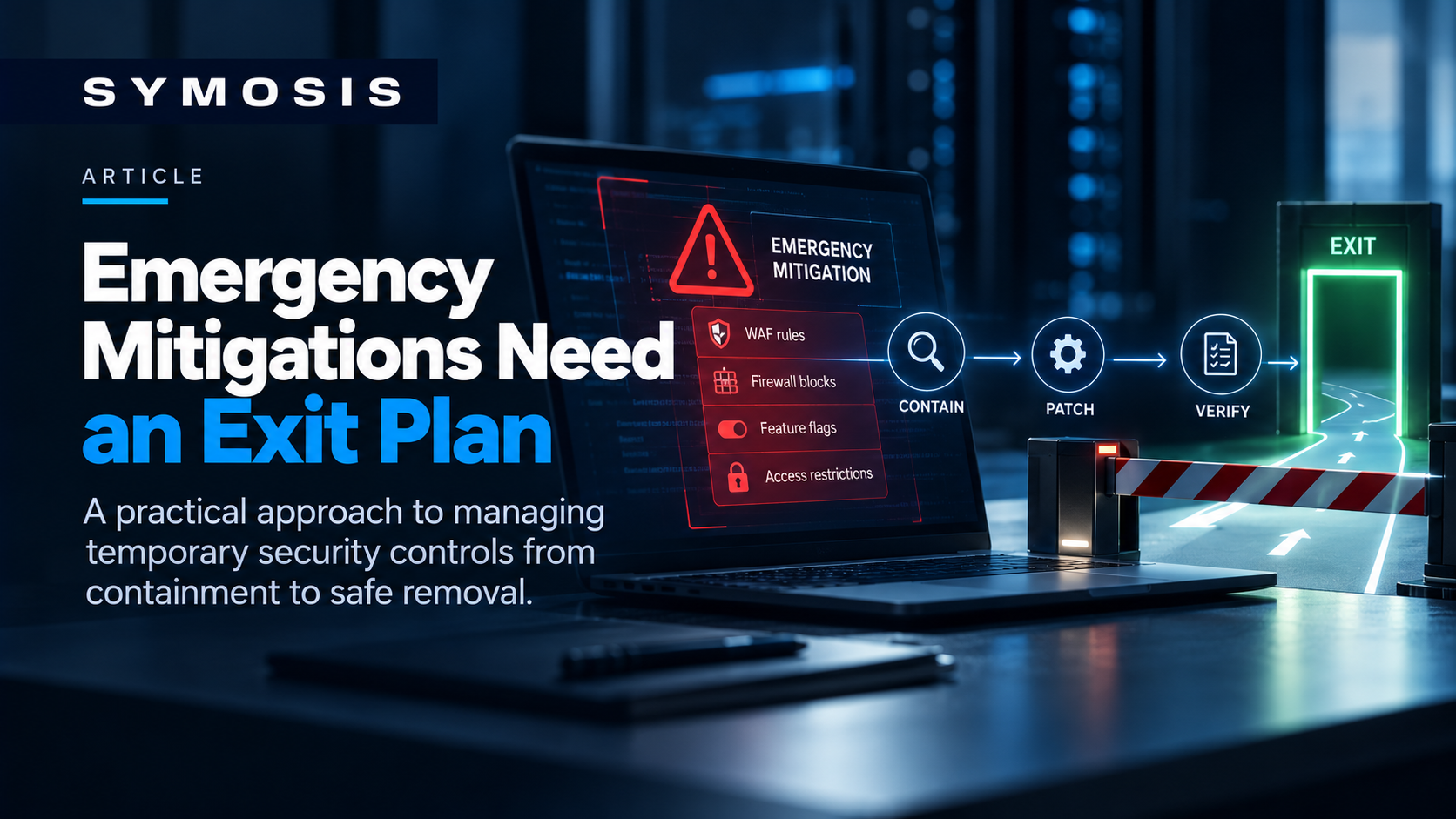
Emergency security controls can reduce exposure fast. Without defined ownership, verification, and removal criteria, they can become a source of long-term risk.
On October 21, 2026, the PHP project released emergency fixes for two critical unauthenticated remote-code-execution vulnerabilities in the core runtime. AWS published AWS WAF mitigations for exposed workloads while making the hierarchy clear: a WAF can help reduce exposure, but patching remains the complete fix.
That distinction applies far beyond this incident.
During an emergency, teams introduce WAF signatures, firewall blocks, feature flags, route changes, EDR policies, disabled functions, or temporary access restrictions. These controls can be necessary to reduce immediate risk. They also create operational debt if the organization cannot prove where they were deployed, what they cover, when they can be removed, and whether the underlying vulnerability has actually been fixed.
The engineering principle is simple: an emergency mitigation must be managed as a time-bound control object, not an informal configuration change.
1. Define the emergency mitigation as a control object
Every emergency mitigation should have one traceable record linking seven essential elements.
1.1 Vulnerable condition
Record the relevant CVE or failure mode, affected versions, exploit preconditions, externally reachable paths, and authoritative advisory.
A generic ticket such as “block PHP exploit” is not sufficient. The technical condition must be specific enough for engineering teams to determine whether an asset is affected and whether the mitigation applies.
1.2 Covered assets and traffic paths
Map the applications, hostnames, accounts, regions, load balancers, origins, internal routes, APIs, and alternate ports that the control is expected to protect.
A WAF rule attached to a public hostname does not necessarily protect a directly reachable origin, an internal service path, a second cloud account, or an application that bypasses the shared edge.
Coverage must be demonstrated across actual traffic paths, not assumed from the presence of a rule.
1.3 Mitigation configuration
Preserve the exact rule, policy version, deployment target, operating mode, exclusions, owner, and timestamp.
Treat the mitigation like production code. Use version control or another immutable change history so responders can establish what changed, understand exceptions, and roll back safely.
1.4 Detection and evidence path
Specify which logs prove that traffic reached the control, which events record a match or block, and where those events are retained.
Monitor both exploit attempts and control health. A rule that exists but is attached to the wrong policy is not an effective control.
1.5 Remediation ownership
Name the teams responsible for asset inventory, patching, application testing, deployment, and verification.
The mitigation owner and patch owner may be different people or teams. However, their work must converge on one documented closure decision.
1.6 Removal criteria
Define the evidence required before the temporary control can be relaxed or removed. This should include:
Affected assets reconciled against the relevant inventory and exposure data.
Fixed versions verified in the running environment.
Application regression tests passed.
Direct-origin and alternate traffic paths checked.
Heightened monitoring completed for an agreed period.
Removal should be based on verified remediation, not simply a decline in blocked traffic.
1.7 Expiry and escalation
Assign a review date to every emergency mitigation.
If remediation is delayed, require an explicit risk decision from the appropriate owner. Temporary controls should not silently become permanent architecture because the original incident has faded from attention.
2. Follow a controlled operating sequence
A reliable emergency response connects exposure discovery, evidence preservation, containment, remediation, verification, and eventual removal.
Step 1: Scope the exposure
Use software inventories, image registries, dependency data, runtime observations, and service ownership records to identify affected workloads.
During a fast-moving incident, no single source is likely to be complete. Reconcile the available sources and investigate discrepancies, particularly for internet-facing systems and workloads with unclear ownership.
Step 2: Preserve relevant evidence
When prior exploitation is plausible, preserve relevant evidence before changing system state, in accordance with the organization's incident-response process.
Capture appropriate logs, active processes and connections, cloud control-plane events, endpoint telemetry, and system snapshots where feasible.
The response must account for the urgency of the threat. If continued exposure makes immediate containment safer, block or isolate first as necessary, documenting the decision and the evidence that could not be preserved.
Step 3: Deploy the mitigation progressively
When the threat and available time allow, deploy the mitigation in stages.
Start in observation or count mode where supported. Analyze representative matches, identify false positives, and add narrowly justified exclusions before moving to enforcement.
For active exploitation against an exposed system, immediate blocking may be the safer choice. The decision should be documented rather than treated as an exception to all future controls.
Step 4: Patch the underlying component
A temporary mitigation reduces exposure; it does not remove the vulnerable code.
Validate the application against the fixed build and deploy through the normal release path whenever possible. If an emergency deployment path is necessary, define the approvals, testing, and rollback conditions.
Step 5: Verify the running state
Package repositories, container manifests, and configuration databases can report a patched version while an older process or image continues to serve traffic.
Verify the effective runtime version and, where safe and appropriate, test the vulnerable behavior to confirm that the fix is effective.
The evidence must demonstrate that the running workload—not merely its declared configuration—has been remediated.
Step 6: Remove or deliberately retain the mitigation
Once remediation is verified, remove temporary controls and exceptions that are no longer required.
Some controls may remain valuable as permanent defensive measures. In that case, formally transition them into the normal change-management and ownership process rather than leaving them in an emergency state.
Close the mitigation record only when the asset, control, and remediation evidence agree.
3. Where teams get trapped
Several recurring mistakes undermine otherwise effective emergency responses.
Confusing blocked traffic with remediated systems. A rising block count may demonstrate active targeting. It does not prove that the application is safe or that every vulnerable instance is protected.
Protecting the primary route while missing the origin. Teams may secure the CDN or WAF path while overlooking a directly reachable origin, staging environment, secondary region, or internal API.
Allowing emergency-rule drift. Different accounts and environments receive different configurations, while exclusions accumulate without clear ownership or reliable change history.
Letting temporary controls become permanent. Patching becomes difficult, the mitigation appears effective, and the review date passes. Over time, the rule can create false positives, conceal architectural weaknesses, and complicate future changes.
Losing evidence during remediation. Rapid patching, rebooting, or redeployment can remove the forensic information needed to determine whether exploitation occurred before containment.
These are not merely documentation problems. They are failures to maintain traceability between the threat, the affected environment, the control, and the evidence of remediation.
4. Emergency mitigation review checklist
Before declaring the incident closed, ask:
Have we identified every affected runtime and reachable path?
Is the mitigation deployed everywhere intended, with verifiable telemetry?
Have we checked bypass routes and justified every exclusion?
Have we preserved evidence where prior exploitation was plausible?
Is the underlying component patched, and have we verified the running version?
Has the application passed targeted regression tests?
Are monitoring and incident-response teams watching for exploitation attempts?
Does the temporary control have a named owner, expiry date, and removal criteria?
Can we explain the residual risk and the evidence supporting closure?
If these questions cannot be answered, the incident may be contained, but the organization has not yet demonstrated that the risk is fully resolved.
5. Put emergency controls inside the patch-management lifecycle
NIST SP 800-40 Rev. 4 frames enterprise patch management as preventive maintenance involving prioritization, deployment, verification, and continuous improvement.
Emergency mitigations belong inside that lifecycle.
A WAF rule, firewall block, or temporary access restriction should be linked to the vulnerability it addresses, the assets it protects, the patch that supersedes it, and the evidence required to retire it. That connection allows security, infrastructure, application, and operations teams to work toward a shared definition of closure.
It also makes the response auditable. Teams can establish what was protected, what remained exposed, who accepted residual risk, and whether the remediation actually changed the running environment.
The broader lesson
Speed matters during a critical vulnerability. So does control discipline.
The strongest response is not the fastest rule deployment or the fastest ticket closure. It is a traceable path from exposure, to containment, to verified remediation, to safe removal of the temporary control.
An emergency mitigation is complete only when the organization can prove what it protected, verify that the underlying vulnerability is fixed, and demonstrate why the temporary control can safely be removed.