
Artificial intelligence is becoming part of everyday enterprise operations.
Organizations are integrating large language models (LLMs), generative AI platforms, AI-powered applications and autonomous agents into business workflows. From internal knowledge management to customer operations, AI is changing how enterprise systems access information and execute tasks.
But as AI adoption accelerates, an important question emerges:
Does your organization actually know where its AI security risks exist?
Having an AI usage policy, an approved list of AI tools or an established cybersecurity program does not automatically mean that your AI environment has been technically validated.
AI introduces additional security considerations involving data flows, identities, permissions, model integrations, third-party providers and operational controls.
Without visibility into these areas, organizations may struggle to identify their most important AI security gaps.
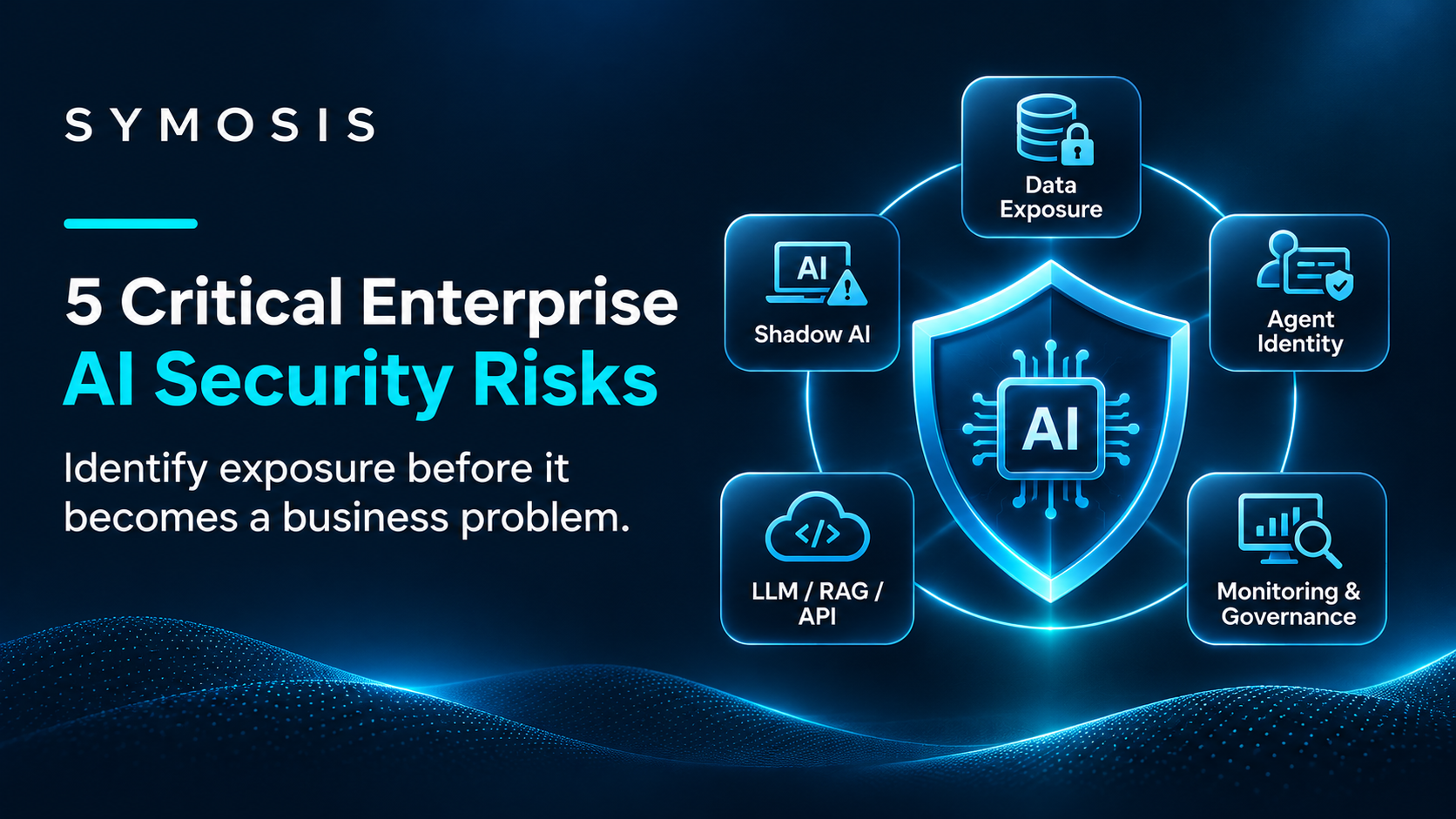
Here are five areas enterprise security teams should evaluate.
1. Shadow AI: Do You Know Where AI Is Being Used?
One of the first challenges is visibility.
Employees and business teams may adopt AI tools independently to improve productivity, summarize information, generate content or automate routine activities.
However, these applications may not always be visible to central IT or security teams.
This creates a shadow AI problem.
When organizations lack visibility into AI usage, they may not know:
- Which AI platforms employees are accessing.
- What categories of enterprise information are being shared.
- Which departments are using unapproved AI applications.
- Whether third-party AI services introduce additional data exposure.
- Who owns and approves individual AI use cases.
AI inventory and use-case discovery should therefore be part of enterprise AI security planning.
Organizations need to understand which AI systems are operating, what they are used for and which business owners are responsible for them.
2. Sensitive Data Exposure Across AI Workflows
AI applications frequently interact with information that organizations need to protect.
This may include customer records, internal documentation, financial information, intellectual property and regulated data.
The risk increases when information moves between enterprise applications, external model providers, APIs and AI-powered services.
Consider an AI assistant connected to an internal knowledge repository.
The security team needs to understand:
- What information can the assistant retrieve?
- Where does that information travel?
- Which external services receive the data?
- Are trust boundaries clearly defined?
- Are sensitive-data access restrictions enforced?
These questions are particularly important for organizations using retrieval-augmented generation (RAG), enterprise AI integrations and connected data platforms.
Data protection should extend beyond the AI model to the entire workflow.
3. AI Agents and Non-Human Identity Risks
AI agents introduce another important security consideration: identity and access management.
Unlike conventional applications that perform predefined operations, AI agents may interpret instructions, interact with tools and execute multiple steps within a workflow.
To perform these tasks, agents may require access to enterprise systems, APIs, databases and other resources.
This introduces questions around:
- Agent identity ownership.
- Non-human identity management.
- Privilege assignment.
- Access restrictions.
- Credential management.
- Agent-to-agent interactions.
An AI agent should not automatically receive broad access simply because it needs to complete a business task.
Organizations should evaluate whether permissions are appropriate for each agent's intended responsibilities.
Identity, privilege and access controls must remain part of the AI security architecture.
4. AI Architecture, LLM, RAG and API Security
Enterprise AI environments often consist of multiple interconnected components.
A typical implementation may involve an LLM, external model provider, API integrations, internal data sources, vector databases and orchestration services.
Each component introduces potential security considerations.
For example, an insecurely configured API integration may expose information beyond its intended scope.
A RAG implementation may retrieve sensitive documents without adequately enforcing user permissions.
An external model provider may introduce additional data processing and third-party risk considerations.
Security teams should review:
- AI application architecture.
- Data flows and trust boundaries.
- LLM and model-provider integrations.
- RAG pipelines and retrieval permissions.
- API authentication and authorization.
- Configuration and access controls.
The objective is to understand how these components interact and where security weaknesses may exist.
5. Monitoring, Incident Readiness and Governance
Identifying AI security risks is only part of the process.
Organizations also need to understand how AI-related activities are monitored and governed.
Security teams should evaluate whether they have adequate visibility into AI application activity, access patterns and potential incidents.
Important questions include:
- Are relevant AI activities logged?
- Can unusual access patterns be identified?
- Is there clear ownership of AI security responsibilities?
- Are incident response procedures aligned with AI workflows?
- Are security controls periodically reviewed?
- Can leadership understand which risks require immediate attention?
Governance policies establish expectations, but technical validation helps determine whether the relevant controls are actually implemented.
Both are necessary for effective enterprise AI security.
Why AI Security Requires More Than a Policy Review
AI security cannot be evaluated exclusively through documentation or general governance checklists.
An organization may have an approved AI usage policy and established security standards while still having unvalidated technical configurations, unclear data flows or excessive permissions.
A meaningful AI security review should combine multiple activities:
- Discovery: Identify priority AI use cases, platforms, workflows, owners and relevant technical artifacts.
- Architecture review: Examine architecture, data flows, trust boundaries, identities, logging and relevant configurations.
- Technical validation: Use appropriate discovery and analysis tooling alongside targeted control checks to validate potential exposure and security gaps.
- Risk prioritization: Evaluate findings according to business impact, exploitability and remediation effort.
- Remediation planning: Translate findings into practical security improvements and a prioritized action plan.
This approach helps organizations move beyond assumptions and understand which AI security issues deserve attention first.
What Should an Enterprise AI Security Assessment Deliver?
An effective assessment should provide more than a list of potential vulnerabilities.
Leadership teams need findings that can inform technical decisions, security investments and business priorities.
A focused AI security assessment should aim to deliver:
- Executive AI risk summary.
- Key findings and risk themes.
- Priority architecture and control gaps.
- Practical remediation recommendations.
- A prioritized 90-day action plan.
- Executive readout.
The outcome should help organizations understand their current priorities and determine what needs to happen next.
How Symosis Approaches AI Security Assessment
At Symosis, our approach focuses on engineering-led AI security assessment.
The AI Security Rapid Assessment is designed to identify priority security risks across 3–5 selected AI use cases, platforms or workflows.
The engagement combines stakeholder workshops, architecture review, targeted configuration validation and open-source discovery and analysis tooling where appropriate.
The methodology follows five stages:
- Discover: Identify priority AI use cases, systems, data sources and owners.
- Review: Examine architecture, data flows, trust boundaries, identities and relevant controls.
- Validate: Perform targeted technical checks to validate potential exposure and security gaps.
- Prioritize: Rank findings based on business impact, exploitability and remediation effort.
- Roadmap: Define practical remediation actions and a 90-day action plan.
The engagement is delivered within 7–10 business days, with a fixed fee of 8,000–10,000.
It is a focused technical assessment, not a full enterprise-wide discovery program, certification assessment, source-code review or penetration test.
Start Understanding Your Enterprise AI Security Risks
AI adoption will continue to expand across enterprise applications, infrastructure and business operations.
The challenge for security leaders is to ensure that security visibility, technical validation and remediation planning evolve alongside that adoption.
Waiting until an AI-related security incident exposes a weakness is not a sound security strategy.
Organizations should understand their AI environment, validate their security controls and prioritize the risks that matter most.
Start with a clearer understanding of your AI security posture.
Explore the Symosis AI Security Rapid Assessment Brief to understand the assessment methodology, scope, deliverables and engagement approach.
Download the AI Security Rapid Assessment Brief
Symosis Security
Engineering-led AI security. Practical risk identification. Actionable remediation.